 blog
What Does Artificial Grass Installation Cost in 2026?
Last Updated: October 26, 2026
Quick Summary
The average cost of installing artificial grass in the UK is around £2,000 for a typical garden, with most jobs completed in one to two days. Supply and fit typically runs from £45 to £80 per square metre all-in, sub-base included, though a typical 30 to 40 m² garden is estimated at about £2,400 fully installed including VAT.
- Small gardens carry a higher rate per square metre because fixed costs are spread over fewer square metres.
- Breaking out an old patio can add £300-£600 in labour and disposal alone.
- Restricted access commonly adds a 10-20% surcharge on the labour line.
- Odour-control or zeolite-based infill for pets adds roughly £5-£10 per square metre.
- A 50 m² DIY installation is estimated at £2,000 to £3,000 for materials, plus equipment rental and waste removal.
Table of Contents
- What the Average Artificial Grass Installation Costs in 2026
- Artificial Grass Installation Cost Per Square Metre
- Total Project Costs by Garden Size
- Artificial Grass Installation Cost Factors That Move the Quote
- DIY Artificial Grass Installation Cost: What You Actually Save
- Artificial Grass Cost vs Natural Turf
- Long-Term Ownership Costs and What a Quote Should Itemise
- Request a Quote from Custom Landscapes
- Frequently Asked Questions
What the Average Artificial Grass Installation Costs in 2026
The average cost of installing artificial grass in the UK sits at around £2,000 for a typical garden, according to MyJobQuote's 2026 artificial grass cost guide, with most jobs completed in one to two days. At Custom Landscapes, we quote every project individually because two gardens of the same size can differ by thousands of pounds once access, drainage and ground conditions are accounted for.
That headline figure hides a wide spread. Supply and fit typically runs from £45 to £80 per square metre all-in, sub-base included, based on Checkatrade's 2026 pricing data. A small, flat, easy-access lawn lands near the bottom of that range.
Below, we break down what actually drives the cost of installing artificial grass in the UK, how to compare quotes fairly, and where homeowners routinely overspend. You can also see the artificial grass installation service we provide to judge what a like-for-like job involves.
Artificial Grass Installation Cost Per Square Metre
Per-square-metre pricing is the number to anchor on, because it scales predictably with garden size. Expect £45 to £80 per m² for supply and fit, or roughly £55 to £75 per m² for professional installation alone according to MyBuilder's installation price guidance.
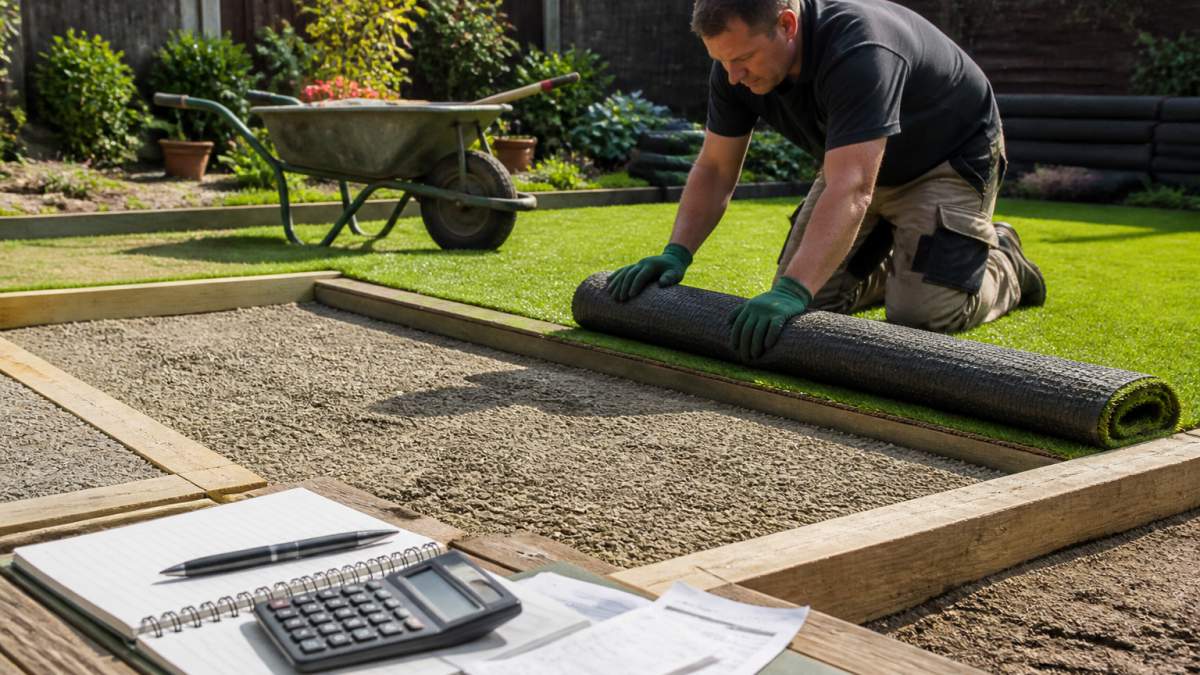
What most guides miss is that the per-m² rate is not fixed. Installers quote a blended rate that assumes a straightforward site.
Supply-Only Turf Versus Supply and Fit
Supply-only turf is the cheaper route on paper, but the gap is smaller than it looks. Budget turf alone often costs a fraction of a fitted price, yet the sub-base, membrane, edging, infill and waste removal still have to be bought and handled.
- Supply and fit: one price covers labour, materials, excavation and disposal
- Supply-only: you buy turf, aggregate and membrane separately, then arrange fitting
- Hybrid: you prepare the ground and an installer lays the turf
For most homeowners, supply and fit wins on time and on risk. The installer carries the waste removal and the levelling, which are the two jobs that most often blow a DIY budget.
Total Project Costs by Garden Size
Total project cost scales with area, but not in a straight line.
| Garden size | Typical area | What drives the total |
|---|---|---|
| Small courtyard | 15-25 m² | Fixed costs dominate; highest rate per m² |
| Standard back garden | 30-50 m² | Blended rate; most common project |
| Large garden | 60-100 m² | Lower rate per m²; more joins and cutting |
| Very large or multiple areas | 100 m²+ | Access and waste removal become the constraint |
A typical 30 to 40 m² garden is estimated at about £2,400 fully installed, including VAT, at roughly £70 per m², per My Lovely Lawn's cost breakdown.
If you are unsure how your garden measures up, our gallery of previous jobs shows completed projects at different scales so you can gauge what your own space will need.
Artificial Grass Installation Cost Factors That Move the Quote
Four factors move a quote more than anything else: ground preparation, access, drainage and the quality of turf specified. Ground preparation and excavation are the most underestimated. Removing an existing lawn, breaking out old paving or digging out compacted clay all add labour and waste costs that a per-square-metre rate rarely captures. A garden with an old patio to break out can add £300-£600 in labour and disposal alone, because concrete and paving cannot go in a standard green-waste skip.
Turf quality matters too. Budget turf has a shorter pile and a denser, more uniform look. Mid-range turf balances appearance and durability. Premium turf carries a longer pile, better backing and a more natural finish. The price gap between budget and premium is real, often £15-£25 per m², but so is the difference in how the lawn looks in year five.
Drainage, Access and Difficult-Site Surcharges
Drainage is the surcharge homeowners ask about least and should ask about first.
Access drives cost just as hard. If a digger or skip cannot reach the garden, everything gets carried by hand, and that labour is charged.
Awkward shapes add cost too. Curves, tight corners and multiple separate areas mean more cutting, more joins and more waste offcuts. A simple rectangular lawn is the cheapest shape to fit; a kidney-shaped lawn with a tree in the middle is not.
Pet- and child-specific requirements
Households with pets or young children often need a specification that costs a little more upfront but performs far better. Standard turf and sand infill can hold odour over time; an odour-control infill or a zeolite-based layer adds roughly £5-£10 per m² but reduces the need to replace the turf early. Enhanced drainage matters more where dogs urinate frequently, because concentrated nitrogen can degrade the backing.
DIY Artificial Grass Installation Cost: What You Actually Save
DIY saves the labour line but rarely the full amount homeowners expect. A 50 m² DIY installation is estimated at £2,000 to £3,000 for materials, £150 to £300 for equipment rental and £200 to £350 for waste removal, based on NeoGrass's 2025 DIY cost breakdown.
Add those up and the saving over a fitted job narrows fast. The real risk is in the groundworks: an uneven sub-base or a missed membrane shows up months later as ripples, poor drainage or weeds pushing through.
Watch out: the most common DIY failure is skimping on the sub-base depth. A shallow aggregate layer compacts unevenly and the turf develops visible dips within a season, which costs more to fix than doing it properly first time.
Artificial Grass Cost vs Natural Turf
Artificial grass costs more upfront than natural turf, and less over time. A new natural lawn is cheaper to lay but needs regular mowing, watering, feeding and weed control, plus re-seeding or re-turfing when it wears thin. Artificial grass carries a higher initial price and near-zero maintenance once installed.
The crossover point depends on how long you stay. Over several years, the maintenance savings on artificial grass tend to close the gap, and the lawn stays usable through winter without turning to mud.
Long-Term Ownership Costs and What a Quote Should Itemise
Long-term ownership costs are modest but not zero, and the biggest variable is how well the installation was specified in the first place. Artificial grass needs occasional brushing, rinsing and removal of leaves and debris. Infill may need topping up every few years, and a badly installed lawn may need re-stretching. None of these are large costs individually, but they add up over a ten-year horizon, and a quote that tells you what is included lets you plan for them rather than discover them.
A realistic itemised example quote
Most guides give you a headline per-square-metre figure and leave you to guess what sits behind it. Below is a representative breakdown for a 40 m² standard back garden with easy side access, a flat lawn and an existing turf lawn to remove.
| Line item | What it covers | Typical range (40 m²) |
|---|---|---|
| Turf supply | Mid-range turf, 30-35 mm pile, including delivery | £600-£900 |
| Excavation and removal of existing lawn | Dig out, load and dispose of old turf and topsoil | £350-£550 |
| Sub-base aggregate | MOT Type 1 or similar, supplied and compacted | £400-£650 |
| Weed membrane | Heavy-duty woven membrane, laid and overlapped | £80-£150 |
| Edging | Timber or composite edging, fixed | £150-£300 |
| Infill | Kiln-dried sand or silica sand, brushed in | £80-£150 |
| Labour | Preparation, laying, cutting, joining and finishing | £700-£1,100 |
| Waste removal | Skip hire and disposal of excavated material | £200-£350 |
| VAT | Charged at the standard rate on the total | 20% of subtotal |
At the mid-point of those ranges the subtotal lands near £2,900 before VAT, or roughly £3,480 including VAT, about £87 per m² all-in. That is deliberately higher than the headline £45-£80 per m² range because it includes excavation, waste removal and edging, which many per-square-metre figures quietly exclude.
What a fair quote should itemise
A fair quote itemises the following. If any line is missing, ask why:
- Turf type, pile height and manufacturer
- Excavation depth and existing lawn removal
- Sub-base type and depth
- Weed membrane specification
- Edging method and materials
- Infill type and quantity
- Waste removal and disposal
- Drainage provisions for the specific site
- VAT and whether the price is fixed
- Warranty terms on materials and workmanship
The customer question we hear most is simple: how do I know you will stick to the budget you quoted? The answer is a fixed, itemised quote with exclusions stated upfront. A quote that lists what is included and what would trigger an extra charge is the one to trust.
Long-term costs to plan for
Over a ten-year life, budget for occasional brushing and rinsing (minimal if you do it yourself), infill top-up every three to five years at roughly £3-£5 per m², and the possibility of re-stretching if the sub-base settles unevenly. Against that, you avoid mowing, watering, feeding, weed control and re-turfing, costs that mount steadily on a natural lawn. The crossover point depends on how long you stay, but the maintenance saving is real and worth factoring into any comparison.
Request a Quote from Custom Landscapes
Comparing quotes is where most homeowners save the most money, and where most confusion creeps in.
At Custom Landscapes, we build artificial grass, paving, decking and fencing projects to a fixed, itemised quote, and we work to your budget rather than around it.
If you are ready to price your own garden, Get a Quote.
The gap between a good artificial grass installation and a disappointing one usually comes down to what happened under the turf, not the turf itself.
Frequently Asked Questions
Is it cheaper to lay turf or artificial grass?
Real turf costs less upfront, usually a fraction of the £45-£80 per m² that supply and fit of artificial grass commands, but it needs watering, mowing, feeding and occasional re-turfing. Artificial grass installation spreads its cost over roughly 15 years of use with minimal upkeep. If you plan to stay in the property, the artificial option often works out cheaper across its lifespan; if you are selling soon, natural turf is the lower-risk spend.
What affects the cost of installing artificial grass?
The biggest drivers are lawn size, turf quality and how much ground preparation is needed. Excavation and waste removal on a choked, uneven lawn add labour and skip hire. Poor drainage may require extra aggregate or a drainage layer. Tight access, slopes and awkward shapes slow the team down. Quote extras such as edging, infill and pet-safe specifications also shift the total, so ask for each itemised separately.
Can I install artificial grass myself to save money?
Yes, and a 50 m² DIY project is estimated at £2,000-£3,000 for materials, £150-£300 for equipment hire and £200-£350 for waste removal. The saving is real, but the sub-base is where DIY jobs fail: insufficient compaction or a weak weed membrane shows up within a season. If your ground is uneven or drains badly, professional installation usually costs less than fixing a failed DIY attempt.
How long does artificial grass installation take?
A straightforward domestic lawn is typically completed in one to three days, with most guides quoting one to two days for an average garden. Ground preparation, excavation and waste removal take the bulk of that time; laying and cutting the turf itself is quick. Sloped sites, poor access or extensive drainage work can stretch the schedule, so confirm the expected duration in your written quote.