 blog
Durable Paving for Family Gardens: What Lasts and Stays Safe
Quick Summary
Durable paving for family gardens is best chosen by matching the surface to how the space is used rather than by price alone. Textured porcelain is the usual starting point for everyday wear, since it is dense, resists staining and frost, and needs little maintenance.
- Porcelain is dense, low in porosity, and generally resists staining, scratching and frost damage well.
- Choose textured, riven or rough-sawn finishes; honed and polished stone can become slippery when wet.
- Concrete is often the most budget-friendly option and handles heavy use well, but it benefits from sealing.
- Plan drainage first, and keep a consistent fall away from the house to avoid ponding.
Table of Contents
- Which Paving Materials Hold Up Best Under Family Use
- Best Paving Slabs for Gardens Where Children Play
- Porcelain Paving Pros and Cons for Family Gardens
- Non-Slip Patio Paving: Choosing a Surface That Stays Safe When Wet
- Low-Maintenance Garden Paving and Long-Term Upkeep
- Drainage, Shade and Climate: Paving Choices That Perform Year-Round
- Booking a Paving Consultation for Your Family Garden
- Frequently Asked Questions
Which Paving Materials Hold Up Best Under Family Use
Durable paving for family gardens is less about picking the most expensive option and more about matching the surface to how the space actually gets used. A patio that hosts barbecues, a path that takes daily pushchair traffic and a play area for young children all place different demands on the ground beneath them.
Most homeowners narrow the choice to four materials: porcelain, natural stone, concrete and brick. Each performs differently once rain, muddy shoes and dropped toys enter the picture.
Porcelain, natural stone, concrete and brick compared
Porcelain is the option most people now start with. It is dense, low in porosity and generally resists staining, scratching and frost damage well. Industry commentary on 2026 outdoor paving trends highlights porcelain's durability, strength and low maintenance as the reasons for its growing popularity NTPavers' Top 10 Outdoor Pavers Trends for 2026.
Natural stone brings a more textured, characterful look, but surface finish matters. Textured natural stone suits family use, while polished or honed finishes can become slippery when wet.
Concrete is the most budget-friendly of the four in many projects, and it handles heavy use well. Its porosity means it benefits from sealing, and it can show moss and algae in shaded, damp corners.
Brick offers a traditional appearance and a reasonable grip underfoot. It is more prone to weathering over time and needs careful base preparation to stay level.
For a family garden, the practical ranking usually runs: textured porcelain for everyday wear, textured natural stone for character, concrete for budget projects, and brick for traditional schemes.
Best Paving Slabs for Gardens Where Children Play
When children play on the surface, the slab itself matters less than its finish and thickness. Look for a textured or riven face, a slab thick enough for the traffic it will carry, and a surface that holds grip when damp.
Paving guidance aimed at family gardens notes that textured porcelain, riven natural stone and rough-sawn granite are generally recommended for good grip, while honed and polished stone are not Paving and Slabs' guide to the best garden paving for families with children. That distinction is the single most useful filter when shortlisting slabs.
Expect a few trade-offs. Textured surfaces can be harder to sweep flat, and very rough finishes may catch small feet during a run. Ask for samples and test them wet before committing.
Porcelain Paving Pros and Cons for Family Gardens
Porcelain suits family gardens for clear reasons. It is strong, resists staining from spilt drinks and barbecue fat, and needs little more than occasional sweeping and a wash.
The drawbacks are worth weighing honestly. Polished porcelain can be slippery, so choose a textured face for play and wet-weather areas. It is also less forgiving of a poorly prepared base, because rigid slabs crack if the ground shifts.
Rain runs off porcelain rather than soaking in. That is useful for keeping a patio dry, but it means drainage must be planned rather than assumed.
Non-Slip Patio Paving: Choosing a Surface That Stays Safe When Wet
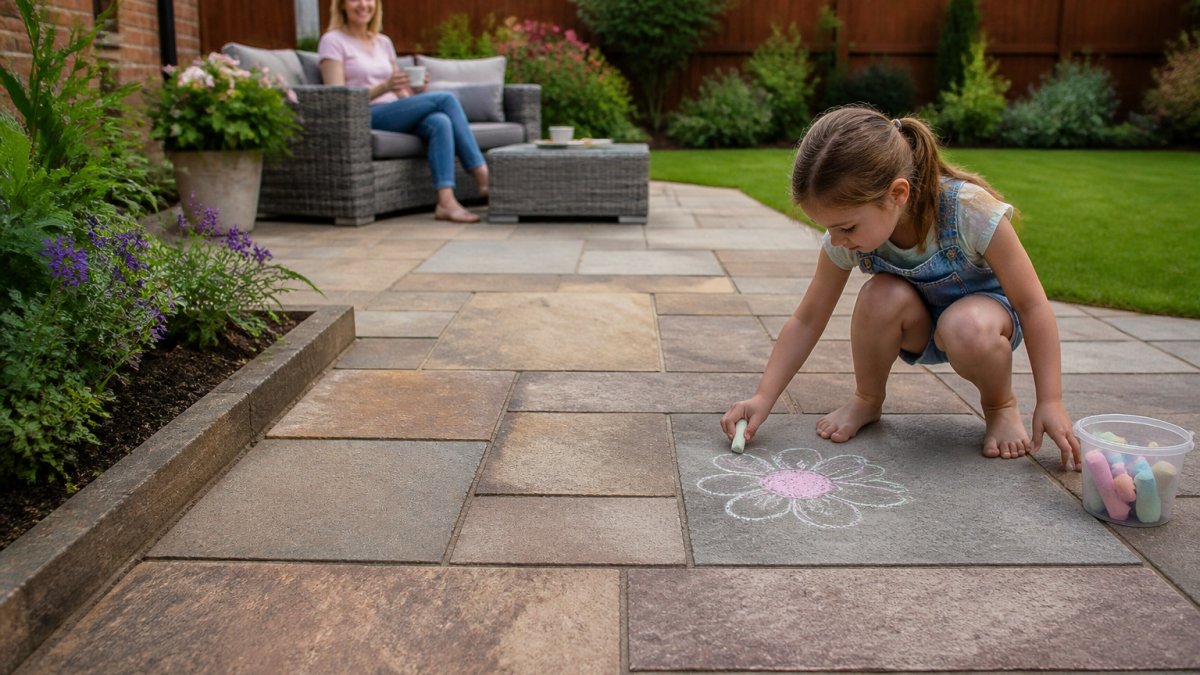
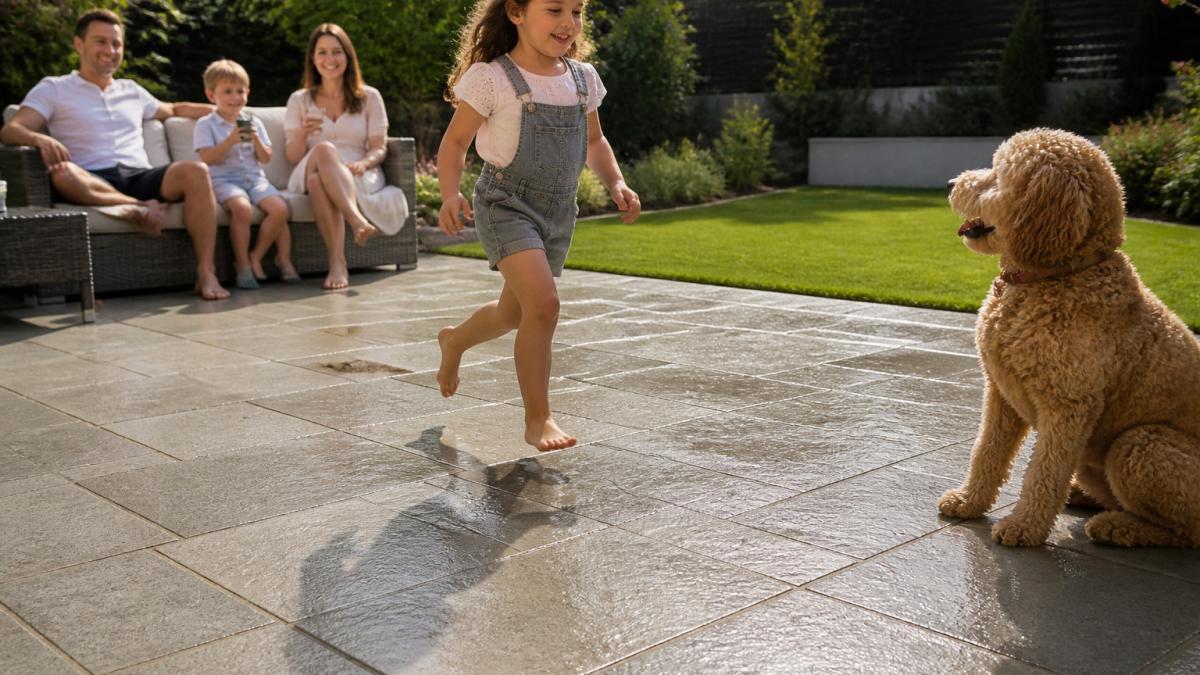
A patio is only useful if it stays safe after rain, and for a family garden, "safe" means safe for a toddler running in socks, a grandparent with a walking stick and a teenager wheeling a bike across it. Surface texture is the starting point, but the finish, the jointing and the drainage all decide whether a slab stays grippy in practice.
What actually makes paving slip-resistant
Grip comes from micro-texture, the tiny roughness on the face of the slab that breaks the film of water between shoe and stone. A polished or honed face has almost none, so water sits on it as a continuous sheet and friction drops sharply. A textured, riven or shot-blasted face holds thousands of tiny drainage points, so the water film breaks up and grip is retained.
Matching the finish to the family use
- Play areas and routes children run on: textured porcelain, riven natural stone or rough-sawn granite. Avoid high-gloss porcelain and polished sandstone anywhere near play equipment, steps or a lawn edge where children cut corners.
- Dining and barbecue zones: a lightly textured porcelain is usually the best compromise, grippy enough when wet, flat enough to seat a table and chairs without wobble.
- Steps and level changes: treat these as the highest-risk spots. Use a textured slab, a contrasting edge and, where the drop is significant, a slip-resistant nosing. Trip hazards at steps cause more family injuries than the slab face itself.
- Paths for pushchairs, wheelchairs and mobility aids: a smooth-but-textured surface with tight, level joints. Very riven or cobbled finishes look characterful but jar wheels and catch toes.
The details that undo a good slab
A grippy slab laid badly is still a hazard. Three things matter as much as the face finish:
- Joint width and jointing. Wide, deep joints collect water and moss; narrow, well-pointed joints shed water and stay cleaner. A permeable jointing grout keeps the surface draining and reduces the algal film that makes even textured stone slippery.
- Fall and ponding. A patio that holds shallow puddles after rain will grow a slippery biofilm within a season. A consistent fall away from the house, commonly around 1 in 60 to 1 in 80 for a patio, keeps water moving.
- Shade and cleaning. North-facing and shaded areas stay damp longer and grow moss and algae faster. Even a good surface becomes slippery once a film forms, so plan periodic cleaning rather than assuming the slab will look after itself.
A quick shortlist for wet-weather safety
If safety is the priority, shortlist textured porcelain, riven natural stone and rough-sawn granite, and rule out polished and honed finishes near steps, play areas and anything that stays damp. Ask for wet samples, check the jointing specification and confirm the fall before the base goes down. Browse our finished paving projects to see how textured finishes look once laid in a family garden.
The table below sums up which finishes suit each family use and why, as covered above.
| Use | Best finish | Why |
|---|---|---|
| Play areas and children's routes | Textured porcelain, riven stone, rough-sawn granite | Breaks up water film for grip |
| Dining and barbecue zones | Lightly textured porcelain | Grippy when wet and flat for tables |
| Steps and level changes | Textured slab with contrasting edge | Highest-risk spots for slips |
| Pushchairs and mobility aids | Smooth-but-textured, tight level joints | Rolls well without catching toes |
| Polished or honed finishes | Avoid near steps and play areas | Water forms a slippery sheet |
| Patio fall | Around 1 in 60 to 1 in 80 | Keeps water from ponding |
Low-Maintenance Garden Paving and Long-Term Upkeep
Low maintenance is largely a question of material and finish. Dense porcelain and well-sealed concrete need the least attention. Natural stone usually needs more care, especially if it is porous.
A simple routine keeps most surfaces performing: sweep regularly, rinse after heavy use, and treat moss before it establishes. Artificial grass can be a sensible, low-upkeep companion for part of a family garden. Our guide to how to install natural-looking artificial grass explains how to combine the two.
Drainage, Shade and Climate: Paving Choices That Perform Year-Round
Paving changes how water moves through a garden, and in a family garden that has consequences for safety, maintenance and how long the surface lasts. The Royal Horticultural Society notes that paving reduces or stops rainfall entering the ground, and that permeable paving can help reduce local flooding and prevent subsidence problems Royal Horticultural Society guidance on front gardens and permeable paving. Getting drainage right at the design stage is far cheaper than fixing a waterlogged patio later.
Drainage: where the water actually goes
A common pattern is for homeowners to choose a beautiful slab and only then ask where the water will go. Reversing that order, drainage first, slab second, avoids the most expensive mistakes.
Frost and freeze-thaw
Winter performance separates a surface that lasts from one that spalls. Frost damage happens when water soaks into a porous slab or the bedding layer, freezes, expands and pushes the surface apart. Dense, low-porosity materials, porcelain in particular, resist this well. Porous concrete, some sandstones and poorly sealed surfaces are more vulnerable, especially where the base does not drain.
Heat underfoot
In a sunny garden, surface temperature matters for bare feet and pets. Lighter-coloured porcelain and pale natural stone reflect more heat and stay cooler underfoot than dark concrete or dark brick, which can become uncomfortably hot on a still summer day. If children play barefoot or a dog uses the patio, a lighter, textured surface is the more comfortable choice.
Shade, damp and seasonal upkeep
Shaded areas stay damp longer, which encourages moss and algae. Choose a textured, low-porosity surface there and plan for regular cleaning rather than hoping the slab will stay clear. In autumn, fallen leaves hold moisture against the surface and speed up algal growth, so sweeping is a genuine durability measure, not just tidying.
Booking a Paving Consultation for Your Family Garden
Choosing durable paving for a family garden comes down to texture, drainage and how the space will be used day to day. When you are ready, you can contact Steven to arrange a consultation and talk through your options.
Frequently Asked Questions
What is the most durable paving for a garden?
Request a quote from Custom Landscapes for current figures.
Is porcelain paving suitable for families with children?
Porcelain paving suits family gardens well when the surface has a textured or matt finish. It is hard-wearing, resists scratches and staining, and is easy to clean after muddy play. Polished or highly glazed finishes can become slippery when wet, so families with young children should ask for a textured option. Porcelain can also feel cool underfoot in winter, which is worth considering for play areas used year-round.
Which paving is least slippery when wet?
Textured porcelain, riven natural stone and rough-sawn granite are generally better choices where grip matters. Honed and polished stone offer a smoother finish that can become slick in rain. The slip resistance of any paving depends on its surface texture rather than material alone, so check the finish before buying. Keeping paving clear of algae and moss also improves grip throughout the year.
How do you choose paving that is safe for children and pets?
Start with a textured, slip-resistant finish and avoid heavily polished surfaces. Choose slabs with a flat, even laying pattern to reduce trip hazards, and check that joints are tightly filled. Consider how the surface reacts to rain, as permeable options can help water drain away and reduce standing puddles. Custom Landscapes can talk through options for your household and site during a consultation.